
Internationalization at Zewail City.

Science without borders, built in Egypt.

Partner with Egypt's national project for science, technology and innovation. One university, five research institutes and an innovation park, on one campus.

Founded by Dr. Ahmed H. Zewail, Nobel Laureate in Chemistry, 1999

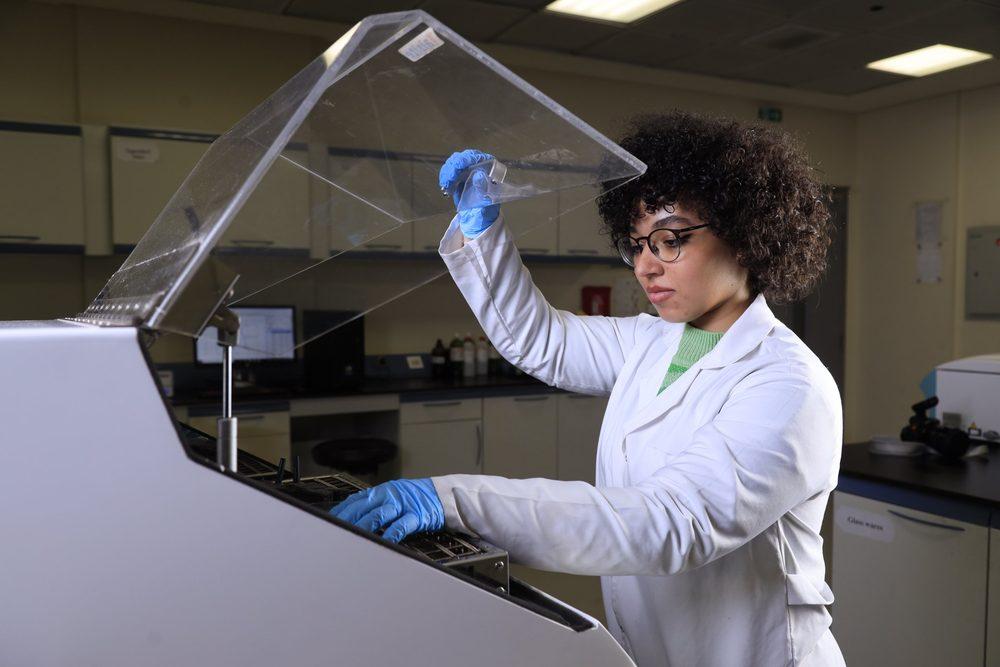
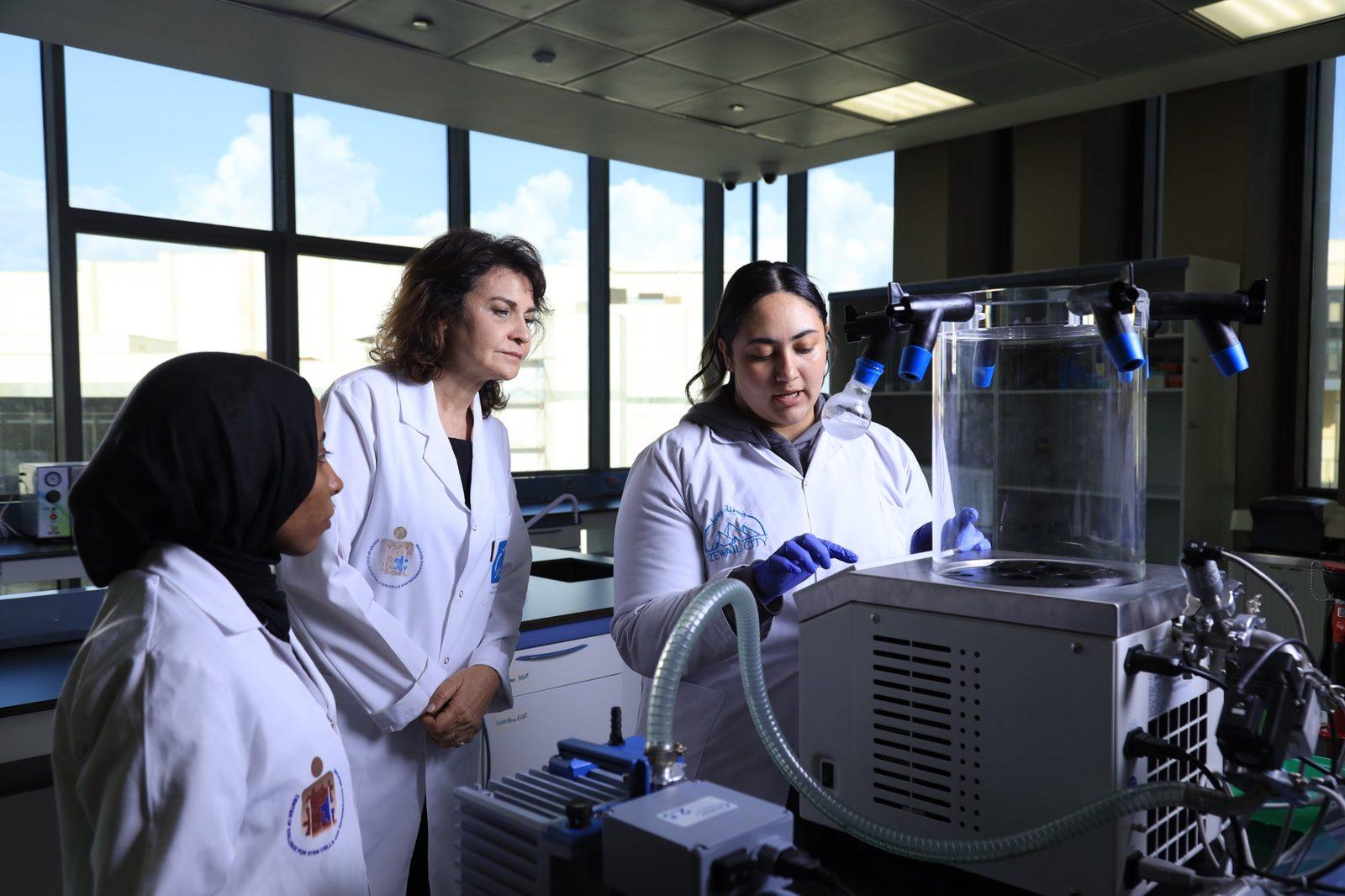
A Zewail City researcher explains a lab instrument to two colleagues
How we choose partners

Every partnership answers three questions

Sustainability is the ground our international work stands on. We give priority, resources and visibility to agreements that pass this test.

A marble platform linking three scenes: a green globe with rising glass bar charts for the SDGs, a relief map of Egypt with university campuses along the Nile for Egypt Vision 2030, and two academic buildings joined by a bridge of students and researchers for lasting two-way partnership.
1

Which SDG targets does it advance?

And how will we both measure that progress?

We name specific SDG targets in every agreement, not broad goals. Both partners agree on shared indicators at signing and review them together each year.

Targets we often advance

  • SDG 4.3 Access to higher education
  • SDG 9.5 Research capacity
  • SDG 13.3 Climate education
  • SDG 17.6 Science cooperation

How we measure

Shared indicators in the agreement. Annual joint review. Results reported in our Sustainability Report and THE Impact Ratings evidence.
2

How does it support Egypt Vision 2030?

And the National Strategy for Higher Education and Scientific Research.

We link every partnership to a national priority. The work must build Egypt's knowledge economy, not only our own profile.

What we look for

  • A clear Vision 2030 pillar: knowledge, innovation and scientific research
  • A national research priority, such as water, energy, health or AI
  • A route from research to industry through our Innovation Park

How we measure

Each agreement carries its national priority tag in the ZC MOU and Partnership Database. We report alignment to the Ministry each year.

3

Does it create lasting value for both sides?

Joint work, mobility and outputs, beyond a signed MOU.

A signature is a start, not a result. We commit to activity that both institutions can see, count and build on.

What we look for

  • Joint research, co-authored papers and shared funding bids
  • Student and staff mobility in both directions
  • Named leads on each side and a first activity within 12 months

How we measure

We track outputs per agreement. Agreements with no activity after 24 months go to review for renewal or closure.

The test in practice

  1. Step 01

    Screen

    The International Cooperation Office checks every proposal against the three questions before signing.

  2. Step 02

    Strengthen

    If a proposal falls short on one question, we work with the partner to close the gap first.

  3. Step 03

    Prioritise

    Agreements that pass all three receive priority for funding, staff time and visibility on our channels.

Have a partnership in mind? See how to start one

Our partners

Where we work, and where we are going

We follow the national sequence: Africa and the Arab region first, then Europe and Asia, then North America. Programs run in English, with French-medium offerings under study.

Now, 2026 to 2027

Africa and the Arab region

Regional outreach and research-track recruitment.

Next, 2028 to 2029

Europe and Asia

First channels, including French grandes écoles and Horizon Europe consortia.

Then, 2030 onward

North America and global

Wider recruitment and scaled partnerships.

Map 1 of 7

Our partner countries

Countries and regions where Zewail City researchers co-authored papers, 2022 to 2026.

UAE: collaboration partnerArmenia: collaboration partnerArgentina: collaboration partnerAustria: collaboration partnerAustralia: collaboration partnerAzerbaijan: collaboration partnerBangladesh: collaboration partnerBelgium: collaboration partnerBurkina Faso: collaboration partnerBulgaria: collaboration partnerBrazil: collaboration partnerBelarus: collaboration partnerCanada: collaboration partnerSwitzerland: collaboration partnerChile: collaboration partnerChina: collaboration partnerColombia: collaboration partnerCosta Rica: collaboration partnerCuba: collaboration partnerCyprus: collaboration partnerCzechia: collaboration partnerGermany: collaboration partnerDenmark: collaboration partnerDominican Republic: collaboration partnerAlgeria: collaboration partnerEcuador: collaboration partnerEstonia: collaboration partnerSpain: collaboration partnerEthiopia: collaboration partnerFinland: collaboration partnerFrance: collaboration partnerUnited Kingdom: collaboration partnerGeorgia: collaboration partnerGhana: collaboration partnerGreece: collaboration partnerCroatia: collaboration partnerHungary: collaboration partnerIreland: collaboration partnerIsrael: collaboration partnerIndia: collaboration partnerIraq: collaboration partnerIran: collaboration partnerIceland: collaboration partnerItaly: collaboration partnerJordan: collaboration partnerJapan: collaboration partnerSouth Korea: collaboration partnerKuwait: collaboration partnerKazakhstan: collaboration partnerLebanon: collaboration partnerSri Lanka: collaboration partnerLithuania: collaboration partnerLuxembourg: collaboration partnerLatvia: collaboration partnerLibya: collaboration partnerMorocco: collaboration partnerMontenegro: collaboration partnerMexico: collaboration partnerMalaysia: collaboration partnerNigeria: collaboration partnerThe Netherlands: collaboration partnerNorway: collaboration partnerNew Zealand: collaboration partnerOman: collaboration partnerPeru: collaboration partnerPhilippines: collaboration partnerPakistan: collaboration partnerPoland: collaboration partnerPuerto Rico: collaboration partnerPalestine: collaboration partnerPortugal: collaboration partnerQatar: collaboration partnerRomania: collaboration partnerSerbia: collaboration partnerRussia: collaboration partnerRwanda: collaboration partnerSaudi Arabia: collaboration partnerSweden: collaboration partnerSlovenia: collaboration partnerSlovakia: collaboration partnerSyrian Arab Republic: collaboration partnerThailand: collaboration partnerTunisia: collaboration partnerTurkey: collaboration partnerTaiwan: collaboration partnerUkraine: collaboration partnerUganda: collaboration partnerUnited States: collaboration partnerUruguay: collaboration partnerUzbekistan: collaboration partnerVenezuela: collaboration partnerVietnam: collaboration partnerYemen: collaboration partnerSouth Africa: collaboration partnerEgypt (home)
PartnerEgypt (home)No data

Source: Scopus export, 5 November 2026. 636 publications with international collaboration, 2022 to 2026. 2026 is a partial year. Hover a country for its figure.

This map shows research collaboration. Signed agreements appear in the partner list.

Coming to Zewail City

One welcome service, from visa to graduation

Students, faculty, researchers and delegations deal with one team, not five offices.

Choose a topic to see how we help

Visas and security clearance

Most visitors enter Egypt on an e-visa. We send your invitation letter and file any approvals your visit needs.

  • Check if your nationality qualifies on Egypt’s official e-visa portal, visa2egypt.gov.eg. A single-entry e-visa allows a stay of up to 30 days. Apply at least seven days before you travel.
  • The portal lists the current fee. If your nationality does not qualify, apply at an Egyptian embassy or consulate.
  • Send us a copy of your passport, your travel dates and the purpose of your visit. We issue an official invitation letter from Zewail City.
  • Some visits, conferences and research activities need government approval before they take place. We file these requests for you through the official channels, so contact us as early as you can.
  • Students enter on a visa, then we convert it to a student residence after you arrive. See Residence and work permits.
Impact and reports

We report what we can prove

Each figure carries its status. Numbers go live as the Institutional Evidence and Impact Registry verifies them.

  • Verified
  • Provisional

Provisional

636

International co-authored publications, 2022 to 2026

Scopus, 5 Nov 2026

Provisional

99

Partner countries and regions

Scopus, 5 Nov 2026

Provisional

25%

Publications in the global top 10% most cited

Scopus, 5 Nov 2026

Provisional

12,707

Citations of these publications

Scopus, 5 Nov 2026

Our strategy, 2026 to 2032

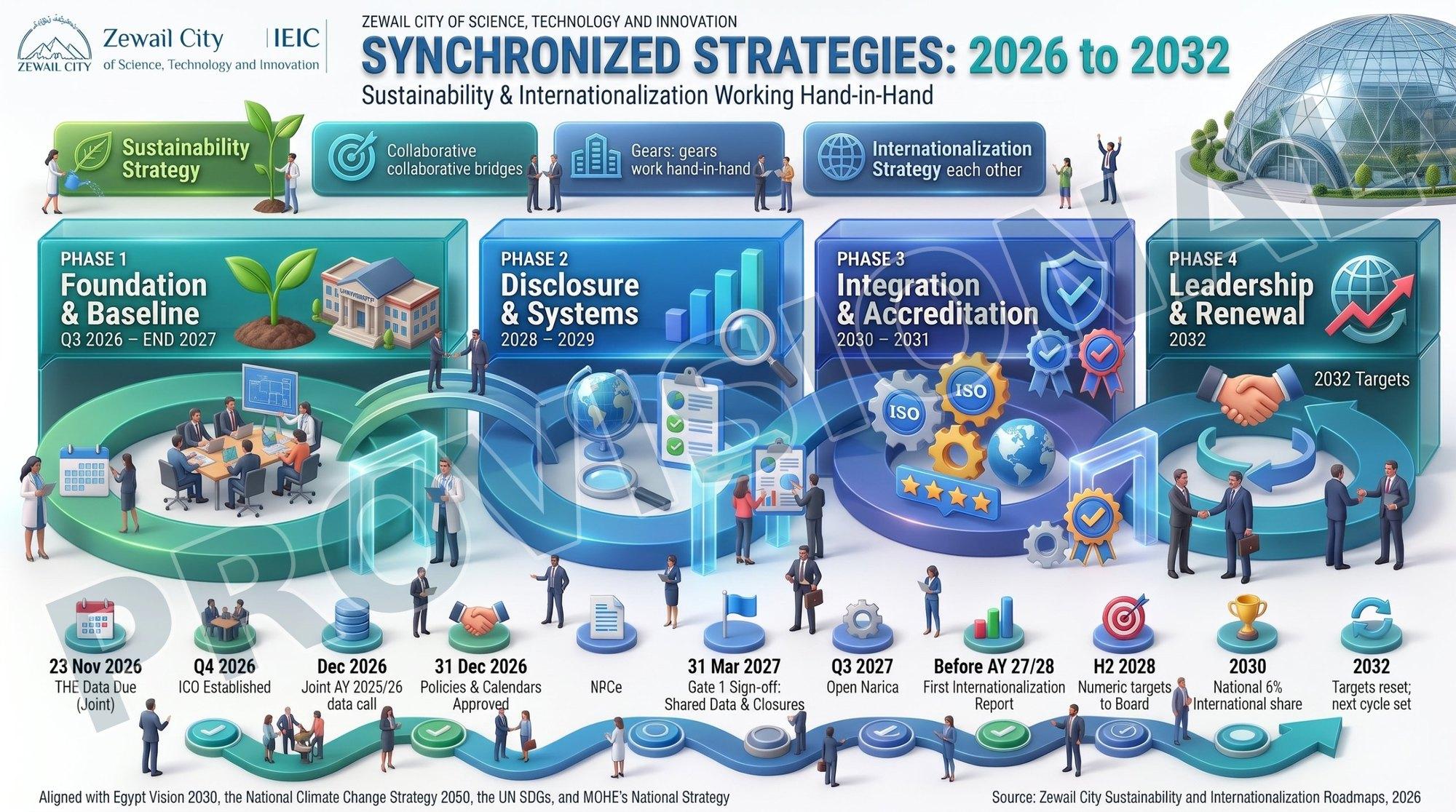
Synchronized strategies: sustainability and internationalization working hand in hand, 2026–2032

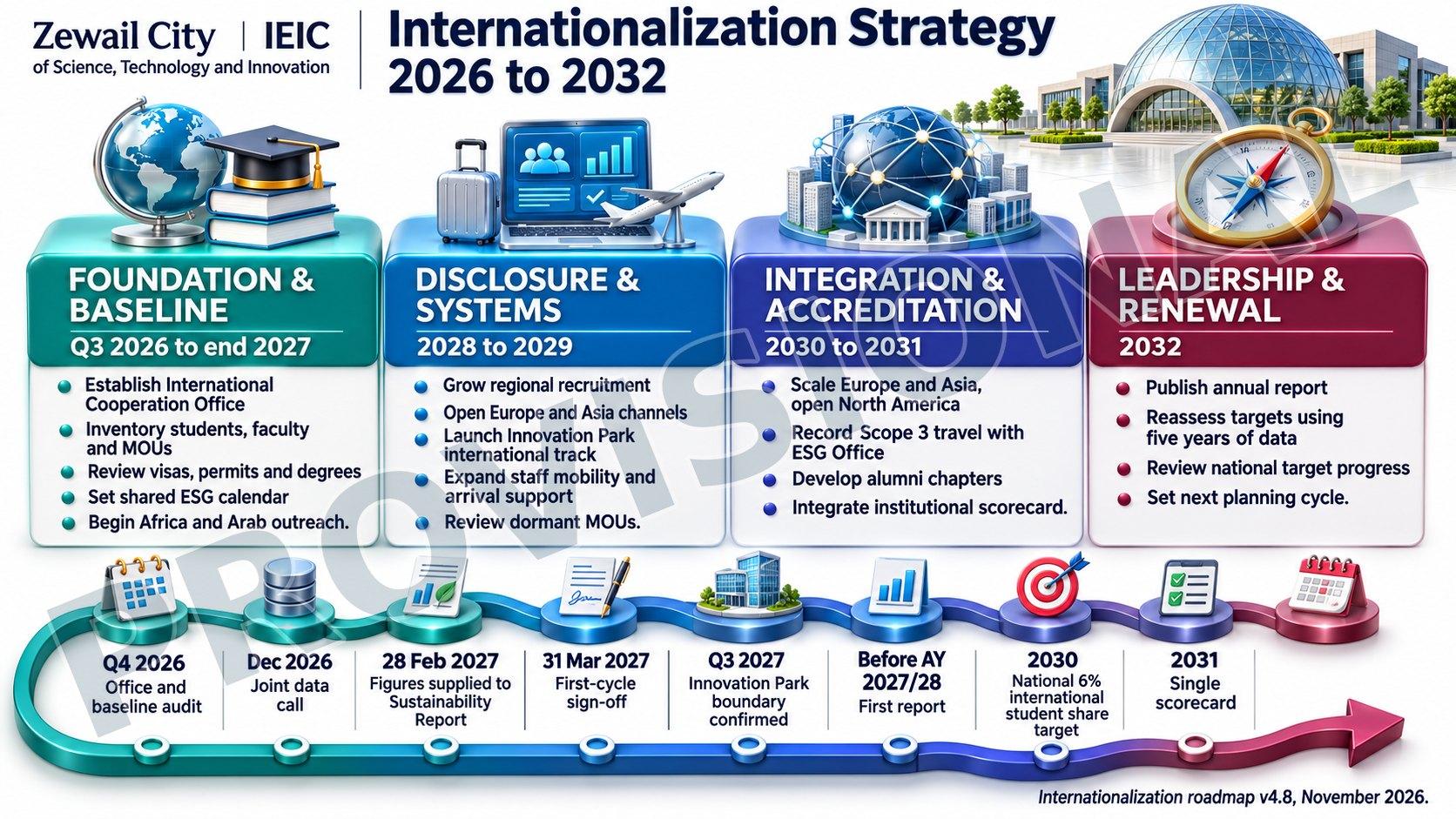
Both strategies share four phases, one data calendar and one institutional scorecard. The roadmaps below are provisional until approved.

Synchronized strategies 2026 to 2032: the sustainability and internationalization roadmaps share four phases, Foundation and Baseline (Q3 2026 to end 2027), Disclosure and Systems (2028 to 2029), Integration and Accreditation (2030 to 2031) and Leadership and Renewal (2032), with joint milestones from the THE data deadline on 23 November 2026 to the target reset in 2032. Marked provisional.
Synchronized strategies, 2026 to 2032. Provisional.
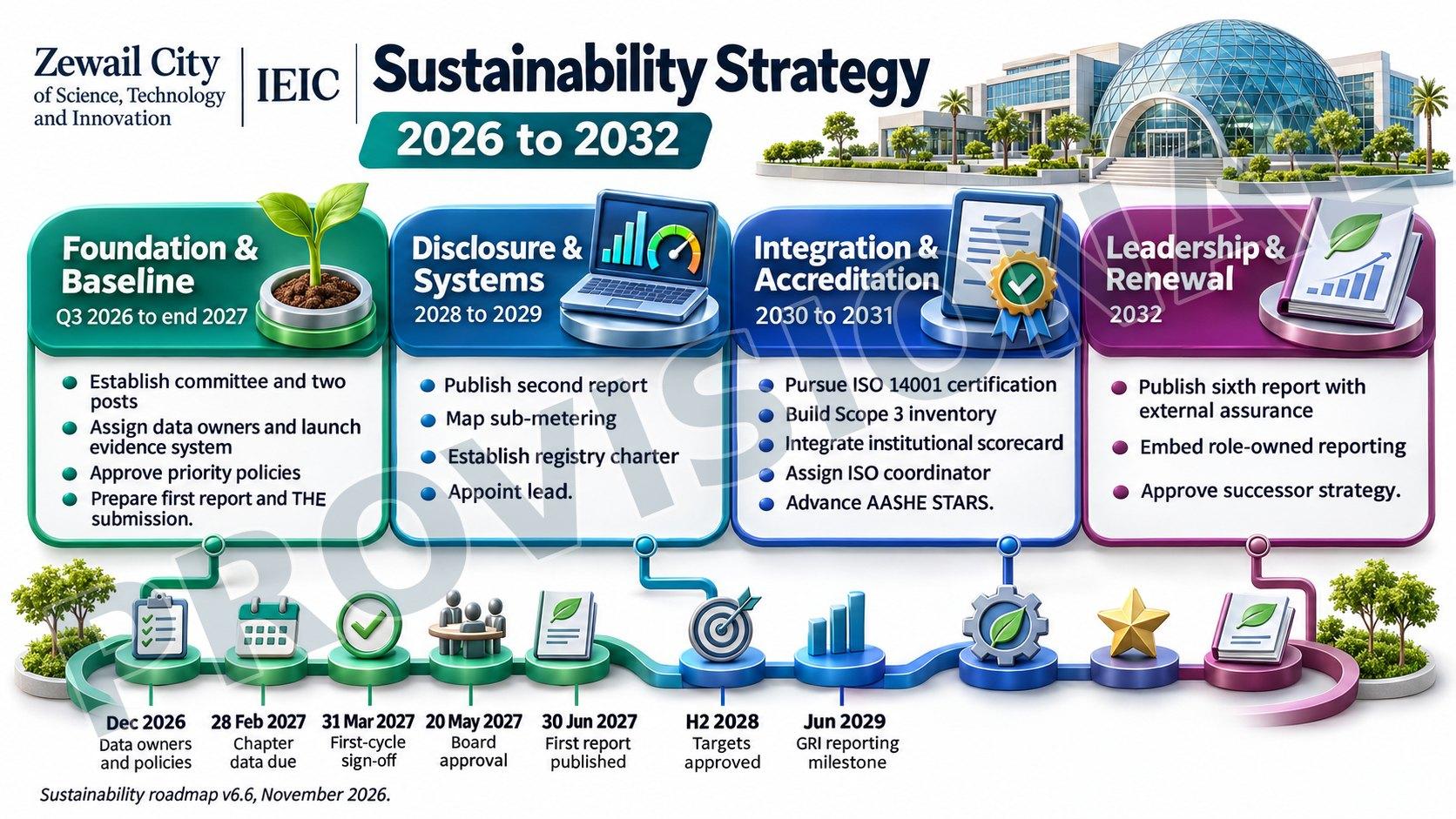
Sustainability Strategy roadmap 2026 to 2032 in four phases, from establishing the committee and first report to external assurance and a successor strategy in 2032, with milestones from December 2026 to June 2029. Marked provisional.
Sustainability Strategy roadmap, v6.6, November 2026. Provisional.
Internationalization Strategy roadmap 2026 to 2032 in four phases, from establishing the International Cooperation Office to reassessing targets in 2032, with milestones from Q4 2026 to the national 6% international student share target in 2030. Marked provisional.
Internationalization Strategy roadmap, v4.8, November 2026. Provisional.
  1. Q3 2026 to 2027 · We are here

    Foundation and baseline

    Office, register, first report.

  2. 2028 to 2029

    Disclosure and systems

    Targets set, new regions open.

  3. 2030 to 2031

    Integration and accreditation

    One institutional scorecard.

  4. 2032

    Leadership and renewal

    Targets reset on five years of data.

Aligned with Egypt Vision 2030, the National Strategy for Higher Education and Scientific Research 2030, and the national goal to double the international student share from 3% to 6%.

Partner with us

From first email to signed agreement in four steps

  1. 1

    Send an enquiry

    Use the form below. We reply within [X] working days.

  2. 2

    Scope and screen

    A call with the right unit, then the three-question test.

  3. 3

    Agree and sign

    One MOU template, one approval process.

  4. 4

    Launch and report

    Your partnership enters the register and our yearly report.

Partnership enquiry

Or contact the right team

Agreements and compliance

MOUs, joint programs, policy.
international.office@zewailcity.edu.eg

Students and staff support

Recruitment, welfare, mobility.
international.office@zewailcity.edu.eg

Events, delegations and media

Visits, communications, rankings.
international.office@zewailcity.edu.eg

News and events

All news