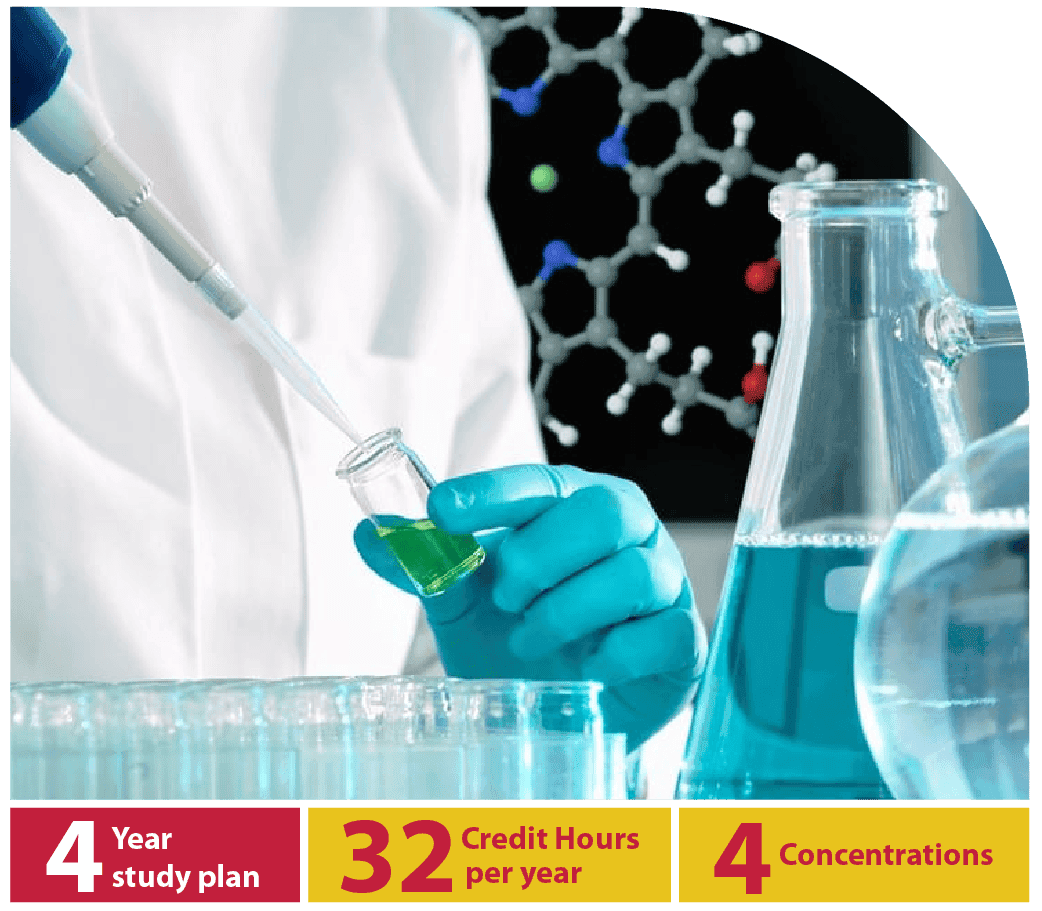
1. Degree Requirements for B. Sc. In Nano Science
A Student who intends to major in Nanoscience has to submit a “Major Declaration Form” upon completion of 34 credit hours of the Foundation Year. A total of 130 credits is required for the bachelor’s degree in Nanoscience Program. Students have to consult their advisors on a regular basis to ensure the prerequisites for their university requirements, School requirements, major requirements, concentration requirements and electives need to be fulfilled.
University Requirements (General Edu.) (Cr) | School Requirements (Math and Basic Sciences) (Cr) | Major Requirements (Cr) | Concentration Requirements (Cr) | Total (Cr) |
16 | 32 | 28 | 54 | 130 |
2. University Requirements
The aim of university requirements is to provide UST students with skills and knowledge to develop an intellectual, well-rounded and successful personal identity. University requirements is a set of Humanities and Social Sciences courses which are designed to enrich students with an appreciative understanding of the natural and cultural environments in which they live and their roles in the society and community services.
University Requirements (16 Cr) |
Compulsory Courses (4 Cr) |
Course Code | Course Title | Cr | L | P |
| ENGL 152 | Effective Speaking and Composition | 2 | 1 | 2 |
| ENGL 153 | Scientific Writing | 2 | 1 | 2 |
Elective Courses (12 Cr) |
Student must select at least 12 Cr from the offered General Education Courses |
3. School Requirements
The aim of School requirements is to provide students of science programs with skills and knowledge essential to develop a successful scientist. School requirements include courses of basic knowledge essential to all graduates of science programs such as Mathematics, Physics, Chemistry, Biology, and Internship.
Compulsory Courses of School Requirements (32 Cr) |
Course Code | Course Title | Cr | L | P |
BIOL 101 | Biology I | 3 | 3 | - |
BIOL 102 | Biology II | 3 | 3 | - |
BIOL 111 | Biology I Lab | 1 | - | 3 |
BIOL 112 | Biology II Lab | 1 | - | 3 |
CHEM 101 | Chemistry I | 3 | 3 | - |
CHEM 102 | Chemistry II | 3 | 3 | - |
CHEM 111 | Chemistry I Lab | 1 | - | 3 |
CHEM 112 | Chemistry II Lab | 1 | - | 3 |
MATH 101 | Calculus I | 3 | 3 | - |
MATH 102 | Calculus II | 3 | 3 | - |
NANOSC 399 | Internship | 2 | - | 6 |
PHYS 101 | Introduction to Classical Mechanics | 3 | 3 | - |
PHYS 102 | Introduction to Electromagnetism | 3 | 3 | - |
PHYS 111 | Introduction to Classical Mechanics Lab | 1 | - | 3 |
PHYS 112 | Introduction to Electromagnetism Lab | 1 | - | 3 |
Total Credits | 32 | |
4. Major Requirements
The program offers a major specialty in Nanoscience, which requires successful completion of at least 28 credits:
Compulsory Courses of Major Requirements- Nanoscience (28 Cr) |
Course Code | Course Title | Cr | L | P |
CHEM 201 | Organic Chemistry | 3 | 3 | - |
CHEM 202 | Analytical and Physical Chemistry | 3 | 3 | - |
CHEM 211 | Organic Chemistry Lab | 1 | - | 3 |
CHEM 212 | Analytical and Physical Chemistry Lab | 1 | - | 3 |
CSCI 101 | Introduction to Computer Science | 2 | 1 | 3 |
MATH 201 | Linear Algebra and Vector Geometry | 3 | 3 | - |
MATSCI 201 | Fundamentals of Materials Science and Engineering | 3 | 3 | - |
NANOSC 301 | Spectroscopy of Nanomaterials | 3 | 3 | - |
NANOSC 302 | Modern Characterization Techniques I | 3 | 3 | - |
NANOSC 305 | Synthesis/Fabrication of Nanomaterials | 3 | 3 | - |
NANOSC 307 | Nano Sciences Research Lab Rotations | 1 | - | 3 |
NANOSC 312 | Modern Characterization Techniques I Lab | 1 | - | 3 |
NANOSC 315 | Synthesis/Fabrication of Nanomaterials Lab | 1 | - | 3 |
Total Credits | 28 | |
5. Concentration Requirements
Nanoscience program offers the following four concentrations, with each one requires successful completion of at least 54 credits:
- Nanomedicine
- Nanophysics
- Bio-nanotechnology
- Nano chemistry
Compulsory Courses of Concentration Requirements – Nanomedicine (54 Cr) |
Course Code | Course Title | Cr | L | P |
BMS 202 | Cell Biology | 3 | 3 | - |
BMS 212 | Cell Biology Lab | 1 | - | 3 |
BMS 204 | Biochemistry | 3 | 3 | - |
BMS 214 | Biochemistry Lab | 1 | - | 3 |
CHEM 203 | Organic Chemistry II | 3 | 3 | - |
NANOSC 308 | Introduction to polymer Science | 3 | 3 | - |
NANOSC 310 | Computer Aided Drug Design | 3 | 2 | 1 |
BMS 205 | Human Physiology | 3 | 3 | - |
NANOSC 309 | Principles of Pharmacokinetics | 3 | 3 | - |
NANOSC 403 | Special Topics in Nanomedicine | 3 | 3 | - |
NANOSC 404 | Principles of Pharmacology | 3 | 3 | - |
NANOSC 405 | Nanopharmaceutics | 3 | 3 | - |
NANOSC 406 | Nanomaterials for regenerative medicine and tissue engineering | 3 | 3 | - |
NANOSC 417 | Nanomedicine Lab | 1 | - | 3 |
NANOSC 458 | Nanoscience Capstone Research Project I | 3 | - | - |
NANOSC 498 | Nanoscience Capstone Research Project II | 3 | - | - |
NANOSC Electives | 12 | 12 | |
Total | 54 | |
Compulsory Courses of Concentration Requirements – Nanophysics (54 Cr) |
Course Code | Course Title | Cr | L | P |
PHYS 201 | Thermodynamics, Wave Motion & Optics | 3 | 3 | - |
PHYS 211 | Thermodynamics, Wave Motion and Optics Lab | 1 | - | 3 |
PHYS 202 | Modern Physics | 3 | 3 | - |
PHYS 212 | Modern Physics Lab | 1 | - | 3 |
MATH 202 | Ordinary Differential Equations | 3 | 3 | - |
NANOSC 306 | Statistical Mechanics I & Thermodynamics for Nanoscale Systems | 3 | 3 | - |
MATSCI 302 | Solid State Physics | 3 | 3 | - |
NANOSC 413 | Photonics & Laser Physics | 3 | 3 | - |
NANOSC 415 | Electronic & Magnetic properties of Nano materials | 3 | 3 | - |
NANOSC 416 | Modeling of Nanomaterials | 3 | 3 | - |
NANOSC 499 | Nanoscience Capstone Research Project | 4 | - | - |
PHYS 210 | Advanced Electromagnetism | 3 | 3 | - |
PHYS 323 | Quantum Mechanics I | 3 | 3 | - |
PHYS 316 | Mathematical Physics I | 3 | 3 | - |
PHYS 348 | Quantum Mechanics II | 3 | 3 | - |
NANOSC Electives | 12 | 12 | |
Total | 54 | |
Compulsory Courses of Concentration Requirements – Bio-Nanotechnology (54 Cr) |
Course Code | Course Title | Cr | L | P |
| PHYS 201 | Thermodynamics, Wave Motion & Optics | 3 | 3 | - |
| PHYS 211 | Thermodynamics, Wave Motion and Optics Lab | 1 | - | 3 |
| PHYS 202 | Modern Physics | 3 | 3 | - |
| PHYS 212 | Modern Physics Lab | 1 | - | 3 |
| MATH 202 | Ordinary Differential Equations | 3 | 3 | - |
| NANOSC 306 | Statistical Mechanics I & Thermodynamics for Nanoscale Systems | 3 | 3 | - |
| MATH 306 | Numerical analysis | 3 | 3 | - |
| NANOSC 411 | Bio-Nanotechnology Lab | 1 | - | 3 |
| NANOSC 303 | Quantum Mechanics | 3 | 3 | - |
| NANOSC 308 | Introduction to Polymer Science | 3 | 3 | - |
| NANOSC 317 | Special Topics in Bio-Nanotechnology | 3 | 3 | - |
| NANOSC 328 | Biological Nanomaterials | 3 | 3 | - |
| NANOSC 408 | Synthetic Biology | 3 | 3 | - |
| NANOSC 409 | Surfaces and colloidal Science | 3 | 3 | - |
| NANOSC 458 | Nanoscience Capstone Research Project I | 3 | - | - |
| NANOSC 498 | Nanoscience Capstone Research Project II | 3 | - | - |
NANOSC Electives | 12 | 12 | |
Total | 54 | |
Compulsory Courses of Concentration Requirements – Nanochemistry (54 Cr) |
Course Code | Course Title | Cr | L | P |
| PHYS 201 | Thermodynamics, Wave Motion & Optics | 3 | 3 | - |
| PHYS 211 | Thermodynamics, Wave Motion and Optics Lab | 1 | - | 3 |
| PHYS 202 | Modern Physics | 3 | 3 | - |
| PHYS 212 | Modern Physics Lab | 1 | - | 3 |
| CHEM 203 | Organic Chemistry II | 3 | 3 | - |
| NANOSC 306 | Statistical Mechanics I & Thermodynamics for Nanoscale Systems | 3 | 3 | - |
| MATH 306 | Numerical analysis | 3 | 3 | - |
| NANOSC 412 | Nanochemistry Lab | 1 | - | 3 |
| NANOSC 303 | Quantum Mechanics | 3 | 3 | - |
| NANOSC 308 | Introduction to Polymer Science | 3 | 3 | - |
| NANOSC 322 | Chemistry & Physics of Nanomaterials | 3 | 3 | - |
| NANOSC 392 | Introduction to Nanochemistry | 3 | 3 | - |
| NANOSC 409 | Surfaces and colloidal Science | 3 | 3 | - |
| MATSCI 480 | Self-assembled Systems | 3 | 3 | - |
| NANOSC 458 | Nanoscience Capstone Research Project I | 3 | - | - |
| NANOSC 498 | Nanoscience Capstone Research Project II | 3 | - | - |
| NANOSC Electives | 12 | 12 | |
Total | 54 | |
Nano Science Program Elective Courses
Nano science Elective Courses |
Course Code | Course Title | Cr | L | P | Prerequisite |
| BMS 201 | General Microbiology | 3 | 3 | - | BIOL 102 Concurrent with BMS 211 |
| BMS 202 | Cell Biology | 3 | 3 | - | BIOL 102 Concurrent with BMS 212 |
| BMS 204 | Biochemistry | 3 | 3 | - | CHEM 201 Concurrent with BMS 214 |
| BMS 205 | Human Physiology | 3 | 3 | - | BOIL 102 Concurrent with BMS 215 |
| BMS 301 | Molecular Biology | 3 | 3 | - | BMS 202 |
| BMS 320 | Introduction to Bioinformatics and Programming Language | 3 | 3 | - | BIOL 102 AND CSCI 101 AND MATH 102 |
| BMS 322 | Structural Biology | 3 | 3 | - | BIOL 102 AND (CHEM 202 OR PHYS 201) |
| BMS 324 | Molecular Genetics and Cell Regulation | 3 | 3 | - | BMS 202 |
| BMS 327 | Neurobiology and Practicum | 3 | 3 | - | BMS 202 |
| BMS 330 | Human anatomy | 3 | 3 | - | BIOL 102 |
| BMS 336 | Stem Cells and Regenerative Medicine and Practicum | 3 | 3 | - | BIOL 102 |
| BMS 337 | Cancer Biology and Practicum | 3 | 3 | - | BMS 202 |
| BMS 344 | Human Embryology | 3 | 2 | 3 | BIOL 102 |
| BMS 364 | Biophysics | 3 | 3 | - | CHEM 202 OR PHYS 201 |
| BMS 404 | Biostatistics | 3 | 3 | - | BIOL 101 |
| BMS 428 | Pathology | 3 | 3 | - | BMS 330 |
| BMS 429 | Molecular immunology | 3 | 2 | 3 | BMS 202 |
| BMS 438 | Human pathophysiology | 3 | 3 | | BMS 330 |
| BMS 430 | Advanced Strategies in Organic Synthesis | 3 | 3 | - | CHEM 201 AND CHEM 203 |
| BMS 456 | Forensic biology | 3 | 3 | - | BMS 202, BMS 204 |
| BMS 459 | Pathogens and Host Defense | 3 | 3 | - | BIOL 102 |
| BMS 465 | Virology | 3 | 3 | - | BIOL 102 |
| CHEM 203 | Organic Chemistry II | 3 | 3 | - | CHEM 201 |
| CIE 101 | Fundamentals of Computer Programming | 3 | 2 | 3 | CSCI 101 |
| CIE 205 | Data Structures and Algorithm Analysis | 3 | 2 | 3 | CIE 202 |
| ENGR 207 | Fluid Mechanics | 3 | 3 | - | PHYS 101 AND MATH 201 |
| ENV 303 | Environmental Chemistry | 3 | 2 | 3 | CHEM 201 |
| MATH 202 | Ordinary Differential Equations | 3 | 2 | 2 | MATH 102 |
| MATH 301 | Probability and Statistics | 3 | 2 | 2 | MATH 102 |
| MATSCI 204 | Inorganic chemistry | 3 | 3 | - | CHEM 101 |
| MATSCI 255 | Introduction to Nanomaterials Synthesis | 2 | 1 | 3 | CHEM 102 |
| MATSCI 301 | Catalysis | 3 | 3 | - | CHEM 101 |
| MATSCI 302 | Solid State Physics | 3 | 3 | - | PHYS 202 |
| MATSCI 303 | Macromolecular Chemistry | 3 | 3 | - | CHEM 101 |
| MATSCI 308 | Computational Modeling | 3 | 3 | - | PHYS 202 AND MATH 202 |
| MATSCI 407 | Functional composites | 3 | 3 | - | CHEM 101 |
| MATSCI 421 | Biomaterials | 3 | 3 | - | |
| MATSCI 480 | Self-assembled Systems | 3 | 3 | - | CHEM 201 |
| NANENG 301 | Micro/Nano Fabrication Techniques | 3 | 3 | - | CHEM 102 AND MATSCI 201 |
| NANOSC 308 | Introduction to Polymer Science | 3 | 3 | - | |
| NANOSC 313 (Equivalent to MATSCI 304) | Advanced Characterization Techniques | 3 | 3 | - | CHEM 101 AND PHYS 102 |
| NANOSC 401 | Nanotoxicology | 3 | 3 | - | NANOSC 305 |
| NANOSC 402 | Nano Imaging | 3 | 3 | | NANOSC 302 NANOSC 305 |
| NANOSC 408 | Synthetic Biology | 3 | 3 | - | |
| NANOSC 317 | Special Topics in Bio-Nanotechnology | 3 | 3 | - | |
| NANOSC 328 | Biological Nanomaterials | 3 | 3 | - | |
| NANOSC 420 | Physics of Nanostructured Semiconductors | 3 | 3 | - | PHYS 202 |
| NANOSC 421 | Nano-Structured Materials & Nanoscale Thin Films | 3 | 3 | - | NANOSC 302 AND NANOSC 305 |
| NANOSC 424 | Kinetics and Energetics in Nanobiological Systems | 3 | 3 | - | CHEM 202 AND BIOL 102 |
| NANOSC 425 | Quantum Theory for Nanoscale Systems | 3 | 3 | - | CHEM 202 |
| NANOSC 426 | Colloidal Nanoscience | 3 | 3 | - | CHEM 202 |
| NANOSC 427 | Biological Routes for Nanomaterials Synthesis & Growth of Nanostructured Materials | 3 | 3 | - | BIOL 102 |
| NANOSC 431 | Nanobiology | 3 | 3 | - | BIOL 102 |
| NANOSC 433 | Nano- and biophotonics | 3 | 3 | - | PHYS 202 |
| PHYS 326 | Mathematical Physics II | 3 | 3 | - | PHYS 316 AND MATH 201 AND MATH 202 |
| PHYS 430 | Quantum Mechanics III | 3 | 3 | - | PHYS 348 |
| PHYS 450 | Computational Physics | 3 | 3 | - | CSCI 101 |
| PHYS 455 | Mathematical Physics III | 3 | 3 | - | PHYS 316 |
| SPC 303 | Remote Sensing & Instrumentation | 3 | 3 | - | PHYS 102 And MATH 202 |
| BMS 332 | Drug Discovery and Development | 3 | 3 | 0 | BMS 204 |
| NANOSC 310 | Computer-Aided Drug Design | 3 | 3 | 0 | |
| MATSCI 425 | Main Group and Transition Metals Chemistry | 3 | 3 | 0 | CHEM 202 |